
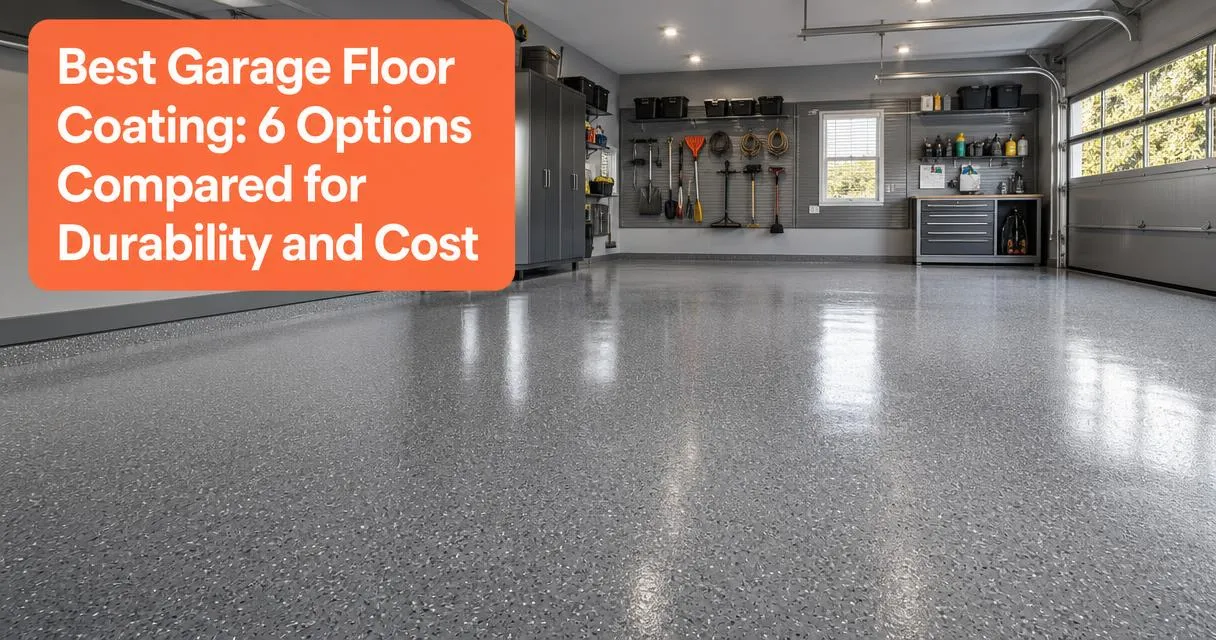
Choosing the best garage floor coating means weighing durability against cost. A budget DIY epoxy kit won’t perform like a professional polyaspartic system. No single coating wins for every homeowner.
The right choice depends on how you use your garage, whether you hire a pro, and your timeline for appearance versus performance.
Key Takeaways
- Polyaspartic and polyurea coatings cure in hours, not days and resist UV yellowing where epoxy fades
- Floor paint and thin sealers cost least upfront but fail quickly under traffic
- DIY epoxy kits can work well, but surface prep determines adhesion success
- Premium coatings save money long-term when you factor in reapplication over 10-15 years
- Professional polyaspartic and polyurea systems outlast all other coating types
- Garage mats and interlocking tiles work for renters but trap moisture underneath and shift under vehicle weight
- Hot climates with direct sun need UV-stable coatings to prevent yellowing
Best Garage Floor Coating Compared
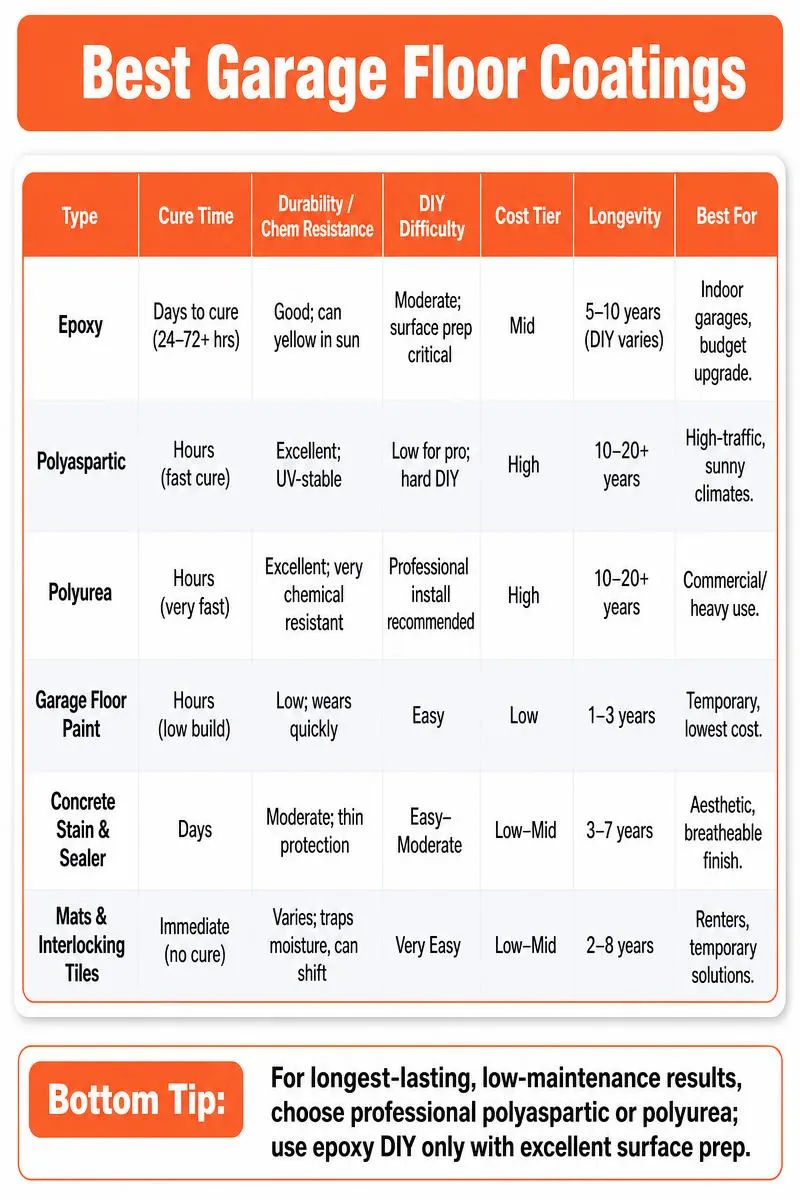
| Type | Cure Time | Durability / Chem Resistance | DIY Difficulty | Cost Tier | Longevity |
|---|---|---|---|---|---|
| Epoxy | Days to cure (24–72+ hrs) | Good; can yellow in sun | Moderate; surface prep critical | Mid | 5–10 years (DIY varies) |
| Polyaspartic | Hours (fast cure) | Excellent; UV-stable | Low for pro; hard DIY | High | 10–20+ years |
| Polyurea | Hours (very fast) | Excellent; very chemical resistant | Professional install recommended | High | 10–20+ years |
| Garage Floor Paint | Hours (low build) | Low; wears quickly | Easy | Low | 1–3 years |
| Concrete Stain & Sealer | Days | Moderate; thin protection | Easy–Moderate | Low–Mid | 3–7 years |
| Mats & Interlocking Tiles | Immediate (no cure) | Varies; traps moisture, can shift | Very Easy | Low–Mid | 2–8 years |
Quick Comparison
Each coating type balances different tradeoffs across durability, cost, and ease of installation.
- Epoxy delivers 5-10 year durability with moderate DIY difficulty and 24-72 hour cure, balancing cost and performance for moderate garage use
- Polyaspartic offers 15-20 year durability with 4-8 hour cure, maximizing longevity and speed for professional installation
- Polyurea provides 15-20 year durability with professional installation, flexible enough for hot climates and high-traffic garages
- Floor paint delivers 1-3 year durability with easy DIY application, simplest option for temporary fixes and low-traffic storage areas
- Stain and sealer offers 1-2 year durability with easy DIY application, minimal protection for tight budgets
- Mats and tiles vary by material quality with easiest install, suits renters and temporary needs
Related Reading
Water-based vs oil-based primer
A clear comparison of water- vs oil-based primers, how they bond to different surfaces, and guidance on which to use…
What Is Epoxy Garage Floor Coating?
Epoxy is a two-part resin system that chemically bonds to prepared concrete through a reaction between resin and hardener. Once mixed, you have a limited working window to apply the coating before it hardens. The cured surface creates a hard, glossy finish that resists chemicals and automotive fluids.
Epoxy works best for budget-conscious homeowners who use their garage for typical family purposes. That includes parking vehicles, light workshop tasks, and seasonal storage. It delivers solid performance for the price when applied over clean, etched concrete.
Several weaknesses affect certain situations:
- Epoxy takes 24-72 hours for foot traffic and up to seven days for vehicle parking
- UV exposure causes gradual yellowing near garage doors and windows
- Moisture vapor causes bubbling and delamination if you skip testing before application
What Is Polyaspartic Garage Floor Coating?
Polyaspartic coatings are fast-curing systems derived from polyurea chemistry. They’re typically applied in multiple layers including a base coat, decorative flake layer, and clear topcoat. The chemistry allows these coatings to cure rapidly in cold temperatures where epoxy would fail.
This coating type works best when you need quick installation without sacrificing long-term durability. Professional installers can complete a two-car garage in one day. You can park vehicles on the surface within 24 hours.
Polyaspartic outperforms epoxy on UV stability, making it ideal for garages with sunlight exposure.
The tradeoffs center on cost and application difficulty. Polyaspartic costs 2-3 times more than epoxy for professional installation. The fast cure time creates problems for DIY applications since you have only 15-30 minutes to work with mixed material.
What Is Polyurea Garage Floor Coating?
Polyurea is an elastomeric coating that stays flexible after curing. This flexibility lets it absorb impacts and thermal expansion without cracking. The coating forms an impermeable barrier against moisture and chemicals.
Polyurea excels in high-traffic garages, workshops with heavy equipment, and climates with extreme temperature swings. The flexibility prevents the brittle cracking that affects rigid epoxy systems. Hot climates benefit most from polyurea’s ability to absorb thermal expansion without cracking.
Most homeowners need professional installation for polyurea systems. The material requires specialized spray equipment and precise mixing ratios. Premium pricing reflects both the advanced chemistry and professional labor required, running well above epoxy costs.
Related Reading
A buyer’s guide to paint-and-primer products, explaining when combo formulas save time and when a dedicated primer or…
What Is Garage Floor Paint?
Garage floor paint is a single-component acrylic or latex coating that sits on top of concrete. It doesn’t bond through chemical reaction like epoxy or polyurea. You apply it directly from the can without mixing resin and hardener.
The thin film dries through solvent evaporation, leaving a colored coating that provides basic stain resistance. Floor paint makes sense for temporary improvements, rental properties, or low-traffic storage areas. Application takes minimal skill and recoating is possible within a few hours.
The performance limitations show up quickly under normal garage use:
- Peels under hot tire contact because paint adheres mechanically, not chemically
- Most garage floor paint fails within 1-3 years under vehicle traffic
- Chemical resistance is minimal compared to true coating systems
What Is Concrete Stain and Sealer?
Concrete stain and sealer systems come in two types. Penetrating sealers soak into concrete pores and react with concrete minerals chemically. Film-forming sealers create a thin protective surface layer.
Decorative stains add translucent color before sealer application. This approach works when you want minimal protection on a tight budget. Stain and sealer combinations let you add color without glossy finish.
The thin protection layer has significant drawbacks:
- Both types require reapplication every 1-2 years
- Penetrating sealers offer no abrasion resistance since they don’t create a surface film
- Film-forming sealers provide slightly better protection but still wear through quickly under traffic
What Are Garage Mats and Interlocking Tiles?
Roll-out mats and rigid interlocking tiles sit on top of your concrete without any bonding or adhesive. They create a removable floor surface you can install quickly and remove later.
Mats typically use rubber or PVC. Tiles come in rigid plastic or rubber with interlocking edges that snap together.
Renters benefit most from these systems since they protect concrete without permanent modification. They also work for temporary coverage while you save for a permanent coating. They suit situations where concrete condition makes coating application impractical.
The fundamental limitation is the lack of bonding to concrete:
- Moisture gets trapped underneath, potentially accelerating concrete deterioration and mold growth
- Mats shift and bunch under vehicle traffic, especially during turning maneuvers
- Tiles can crack under concentrated loads from jack stands or heavy storage
- Neither system seals or protects the concrete itself
Head-to-Head: Durability and Chemical Resistance
- Polyaspartic and polyurea last 15-20 years and resist automotive fluids and salts. Polyurea’s flexibility adds impact resistance that prevents chipping from dropped tools.
- Epoxy delivers strong chemical resistance but tends toward brittleness over 5-10 years. Impact from dropped objects can chip the coating. Thermal cycling can cause hairline cracks over time.
- Paint and stain systems offer minimal protection. Paint softens and peels under heat. Thin sealers wear through quickly under traffic.
- Garage mats protect the surface they cover but provide no concrete sealing.
Head-to-Head: Installation and DIY Difficulty
- Floor paint and stain/sealer are the easiest DIY options, requiring only basic cleaning and roller or sprayer application. A two-car garage needs no specialized tools.
- Epoxy sits in the moderate DIY range. The coating applies like paint, but prep quality determines epoxy success. Required prep includes grinding or acid etching, moisture testing, and crack repair.
- Polyaspartic and polyurea cure too fast for DIY installation. DIY attempts produce visible lap marks and uneven thickness. Professional crews achieve even coverage before curing using specialized tools.
Head-to-Head: Cost, Maintenance, and Longevity
The lowest upfront investment options:
- Floor paint costs $50-150 for a two-car garage in materials
- Stain and sealer runs $100-250 for a two-car garage
- Mats and tiles range from $500-1,500 depending on quality
Polyaspartic and polyurea deliver the best long-term value despite higher initial costs. Professional installation runs $2,500-5,000 for a two-car garage. When you calculate cost per year of service, premium coatings save money long-term.
Maintenance is minimal for premium coatings, usually just occasional mopping. Epoxy occupies the middle ground at $800-2,000 for professional installation or $300-600 for DIY materials. You’ll get 5-10 years before recoating, and harsh cleaners dull the surface.
Head-to-Head: Aesthetic Options
Each coating type offers different visual possibilities:
- Epoxy provides the widest flake selection available with solid colors, multi-color blends, and custom patterns at moderate cost
- Polyaspartic and polyurea add metallic pigments and crystal-clear topcoats that enhance flake appearance beyond epoxy
- Concrete stain creates translucent tones from mineral reactions rather than opaque colors
- Floor paint provides limited solid color options in a relatively narrow palette
- Mats and tiles come in various colors with a distinctly different appearance than coatings
Which Should You Choose?
Your garage use and budget should drive the decision more than marketing claims about any single product.
- Floor paint or stain/sealer suits budget storage garages without hot-tire parking, where you prioritize appearance over long-term durability
- Epoxy works for moderate-use family garages with daily drivers and light workshop tasks, offering solid protection at reasonable cost
- Polyaspartic or polyurea outlasts epoxy in high-traffic garages and show-quality spaces where longevity matters most
- Mats or interlocking tiles protect without permanent modification for renters needing removable coverage
- Hot climates with direct sun need UV-stable polyaspartic to prevent yellowing
FAQs
1. What is 20 times stronger than epoxy?
Marketing claims about polyurea or polyaspartic being “20 times stronger” than epoxy typically refer to tensile strength or elongation before break. This doesn’t translate directly to real-world garage floor performance.
Both polyurea and polyaspartic do outlast and outflex epoxy. But the strength difference matters more for industrial applications than typical residential garages.
2. What is the average cost to epoxy a 2-car garage floor?
Professional epoxy installation for a standard 400-500 square foot two-car garage typically costs $800-2,000 depending on your location, concrete condition, and decorative options. DIY epoxy kits run $300-600 for quality materials. You’re responsible for all prep and application labor with the DIY route.
3. What are the downsides of using epoxy on a garage floor?
- Epoxy yellows under UV exposure, especially near garage doors and windows
- It takes several days to fully cure before vehicle parking
- Epoxy can delaminate if applied over concrete with moisture issues
- Epoxy is more brittle than polyurea, making it prone to chipping from impact
- Surface preparation is critical and time-consuming for successful DIY application
4. What is better than epoxy for your garage floor?
Polyaspartic and polyurea coatings outperform epoxy in cure speed, UV stability, flexibility, and longevity. They cost more upfront but last 15-20 years compared to epoxy’s 5-10 year lifespan. The “better” choice depends on whether the performance justifies the price for your specific garage use.
5. Can I install garage floor coating myself or do I need a professional?
You can successfully DIY epoxy coatings if you invest proper time in surface preparation including grinding, etching, and moisture testing. Floor paint and sealers are even easier for DIY work. Polyaspartic and polyurea cure too fast for DIY, making professional installation the practical choice.
6. How long does a garage floor coating last?
- Floor paint lasts 1-3 years under normal garage conditions
- Sealers need reapplication every 1-2 years
- Epoxy delivers 5-10 years with proper installation
- Polyaspartic or polyurea outlast all other coating types
Actual lifespan varies based on surface prep quality, traffic levels, chemical exposure, and UV light exposure.
7. Which garage floor coating is best for bare concrete?
All coating types can be applied to bare concrete if you properly prepare the surface. Epoxy and polyaspartic provide the best adhesion and protection for previously uncoated concrete. The concrete must meet these requirements regardless of coating choice:
- The surface must be clean and dry
- Concrete must be profiled through grinding or etching
- The slab must be free from moisture issues
Final Verdict
No single coating wins for every situation. Match your choice to how you use your garage and what you’re willing to spend. Consider whether you plan to DIY or hire professionals.
Polyaspartic and polyurea deliver the longest lifespan if budget allows. Epoxy provides the best middle ground between cost and durability for typical family garages. Paint and sealer work for temporary improvement on minimal budget.
The concrete condition underneath matters more than the coating you choose. A premium polyaspartic system fails just as quickly as cheap paint when applied over dirty, moisture-laden, or improperly prepared concrete.
Assess your concrete condition first:
- Look for existing coatings that need removal
- Check for moisture issues
- Evaluate whether cracks need repair
That assessment tells you which coatings are viable before you compare features and prices.
Colorado’s dry climate and temperature swings affect how coatings cure and adhere, and rapid changes can cause adhesion failures in improperly installed systems. Based in Denver, we can assess your concrete, test for moisture issues, and recommend the coating that matches your garage use and budget; see our interior painting services for related interior coating work. Call 720-831-8998 to schedule a garage floor evaluation in the Denver metro area.