You’re staring at two options at the paint store: a can labeled “paint and primer in one” and separate primer and paint. Neither choice wins across the board. The right answer depends on what you’re painting over, how drastic your color change is, and whether your surface has stains, grease, or bare wood.
Key Takeaways
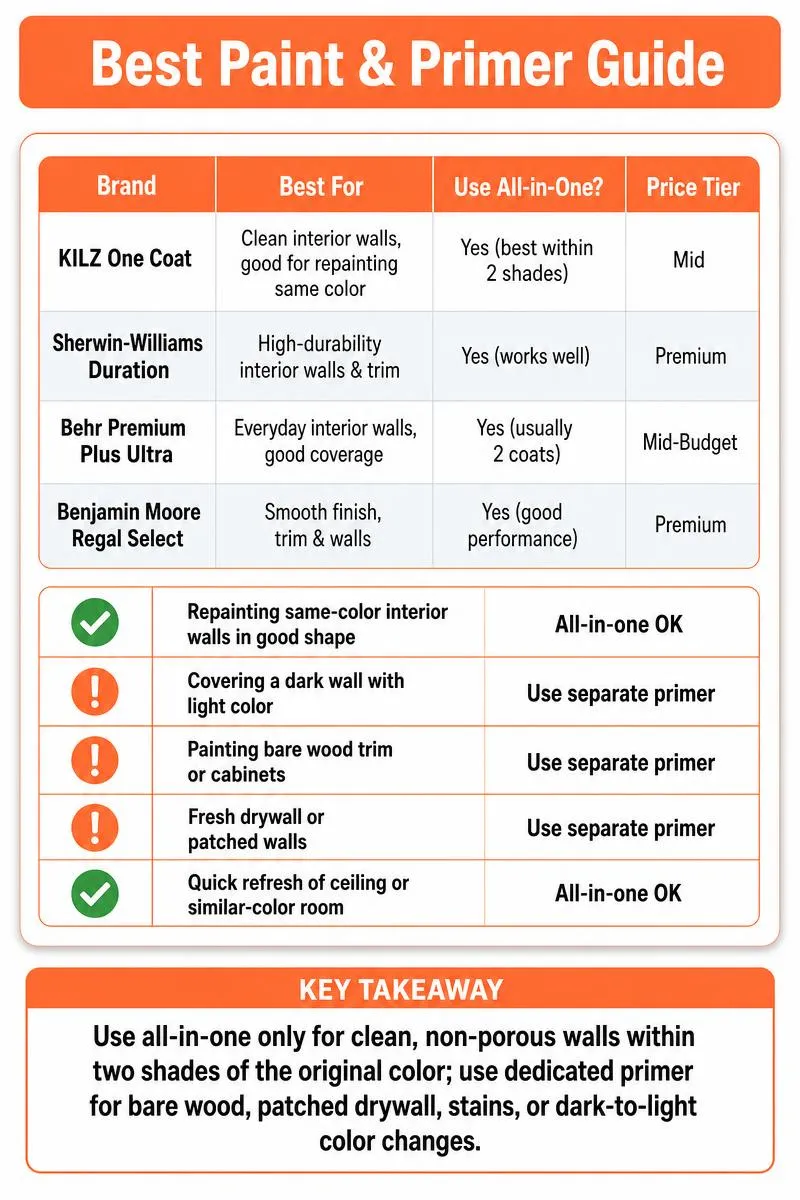
- Paint and primer in one works best on clean, non-porous interior walls when you’re staying within two shades of the original color.
- Separate primer is required for bare wood, patched drywall, smoke or water stains, and any shift from dark to light colors.
- Top-performing brands include KILZ One Coat, Sherwin-Williams Duration, Behr Premium Plus Ultra, and Benjamin Moore Regal Select.
- If one area of your wall absorbs more paint than another (common near repairs), skip all-in-one and use a dedicated primer coat.
- Both product types come in 1-gallon cans for small rooms and 5-gallon buckets for whole-home projects.
- All-in-one products contain higher resin concentrations than standard paint but lack the adhesion promoters and stain blockers in true primers.
- Expect to apply two coats of paint and primer in one on most surfaces, despite “one coat” marketing claims.
Related Reading
A practical roundup of leading exterior paint manufacturers to help you choose a reliable paint-and-primer product for…
Best Paint And Primer In One at a Glance
| Brand | Best For | Use All-in-One? | Price Tier |
|---|---|---|---|
| KILZ One Coat | Clean interior walls; same-color repaints | Yes (best within 2 shades) | Mid |
| Sherwin-Williams Duration | High-durability walls & trim | Yes (works well) | Premium |
| Behr Premium Plus Ultra | Everyday interior walls; good coverage | Yes (usually 2 coats) | Mid-Budget |
| Benjamin Moore Regal Select | Smooth finish for trim & walls | Yes (good performance) | Premium |
What Is Paint and Primer in One?
Paint and primer in one is standard paint with extra binding resins mixed in. It’s not a separate primer layer, it’s thicker paint designed to stick and cover in fewer coats. Manufacturers add more solids and adhesion agents than regular paint, but these products don’t create the chemical bond or stain-blocking barrier that dedicated primers deliver.
All-in-one formulas excel on previously painted interior walls in good condition, especially when you’re moving from beige to gray or white to off-white. They work well on ceilings, where you’re rarely dealing with stains or adhesion challenges. The built-in primer resins help the paint grip smooth drywall that’s already sealed, cutting your project down to two coats instead of three.
The convenience is real. You save an entire drying cycle, which means you can paint a bedroom on Saturday and move furniture back Sunday. For DIYers tackling a straightforward repaint, the simplified process reduces opportunities for application mistakes.
But all-in-one paint fails on problem surfaces. Bare wood soaks up the paint unevenly because there’s no dedicated sealer coat, leaving blotchy coverage and poor adhesion. Grease spots, water stains, and smoke damage bleed through because the formula lacks stain-blocking pigments. Glossy surfaces like old oil-based trim don’t bond well because all-in-one products don’t etch or grip the way bonding primers do.
What Is Separate Primer + Paint?
Separate primer and paint means applying a dedicated primer coat that dries completely, followed by one or two coats of finish paint. The primer’s job is to seal porous surfaces, block stains, and create a bonding layer. The paint’s job is color and durability.
Dedicated primers outperform all-in-one products on bare wood, fresh drywall, patched walls, and any surface with stains or odor. Oil-based primers like Zinsser Cover Stain lock down tannin bleed from cedar and redwood. Shellac-based primers such as BIN block smoke and pet odors that water-based products can’t touch. Stain-blocking primers contain titanium dioxide and specialty pigments that stop dark colors and water marks from showing through your topcoat.
Exterior projects almost always require separate primer. Wood siding, fiber cement, and bare trim need UV-resistant primers that flex with temperature swings. Exterior primers contain mildewcides and moisture barriers that paint and primer in one formulas don’t include.
The tradeoff is time and effort. You’re adding an entire coat to your project, which means more brush cleaning, another round of taping, and at least four hours of drying time before you can apply paint. For beginners, managing two separate products feels more complicated than grabbing one can.
Head-to-Head
Adhesion on difficult surfaces: Separate primer wins decisively. Oil-based bonding primers create a mechanical grip on slick surfaces like old enamel or melamine. Stain-blocking primers seal knots, water damage, and smoke residue that bleed through all-in-one paint even after three coats. If your wall has repairs, texture differences, or any kind of damage, a dedicated primer coat prevents failures.
Speed and convenience: All-in-one wins for straightforward repaints. You eliminate an entire application step and cut at least half a day off your timeline. One trip to the store, one product to mix and apply, fewer opportunities to mess up surface prep between coats.
Cost per project: All-in-one often costs less for simple jobs. A gallon of Behr Premium Plus Ultra covers 400 square feet in two coats. Buying separate primer and paint for the same coverage adds cost and requires more labor. But if you need three coats of all-in-one to cover a stain or dark color, separate primer becomes cheaper because you’ll only need one finish coat.
Color-change performance: Separate primer wins when you’re shifting from dark to light. A gray-tinted primer blocks navy or burgundy walls in one coat, letting your white or cream topcoat cover in two passes. Paint and primer in one requires three or four coats to hide bold colors, wasting time and material.
Wood and exterior surfaces: Separate primer is strongly recommended. Bare wood needs a sealing primer to prevent tannin bleed and uneven absorption. Exterior trim requires alkyd or oil-based primers that bond to weathered surfaces and flex with seasonal movement. All-in-one products don’t contain the mildewcides, UV blockers, and adhesion promoters that exterior primers deliver.
Related Reading
Recommendations for low‑VOC, durable paints and primers tailored to wood surfaces like cabinets and trim.
Which Should You Choose?
Your surface condition and project scope determine the right product. Here are five common scenarios with clear recommendations.
1. Repainting Same-Color Interior Walls in Good Shape
Use paint and primer in one. If your walls are clean, free of stains, and you’re staying within a shade or two of the current color, all-in-one products like Sherwin-Williams Duration or KILZ One Coat deliver solid coverage in two coats. You’ll save time and money without sacrificing finish quality.
2. Covering a Dark Wall With Light Color
Use separate primer and paint. Apply a gray-tinted primer first to block the dark base color, then follow with two coats of your light finish paint. Trying to cover charcoal with white using all-in-one paint wastes material and leaves you applying four or five coats.
3. Painting Bare Wood Trim or Cabinets
Use separate primer. Oil-based primers like Zinsser Cover Stain seal wood grain and prevent tannin bleed that ruins your topcoat. Sand lightly between primer and paint for a furniture-smooth finish. All-in-one paint on bare wood absorbs unevenly and shows every flaw.
4. Fresh Drywall or Patched Walls
Use separate primer. Unpainted drywall and spackled patches absorb paint at different rates, creating flat spots and shiny areas if you skip primer. A PVA drywall primer like Zinsser Drywall PLUS seals everything uniformly so your finish coat looks consistent.
5. Quick Refresh of Ceiling or Similar-Color Room
Use paint and primer in one. Ceilings rarely have stains or adhesion issues, and you’re typically staying white or off-white. Behr Premium Plus Ultra covers most ceilings in two coats and cuts your project time in half.
FAQs
Do paint and primer in one really work?
Yes, on the right surfaces. They work well on previously painted, clean interior walls when you’re making minor color changes. They don’t work on bare wood, stained surfaces, or drastic color shifts where you need true stain blocking and sealing.
Is all-in-one paint and primer good for every surface?
No. Skip it on bare wood, fresh drywall, patched walls, grease or smoke damage, and glossy surfaces. All-in-one products lack the adhesion promoters and stain blockers that dedicated primers provide for problem surfaces.
Is there a paint with primer already in it?
Yes, that’s exactly what paint and primer in one products are. Brands like KILZ, Behr, Sherwin-Williams, and Benjamin Moore all make versions with higher resin content designed to prime and paint in fewer coats. Just remember they’re enhanced paint, not true primer.
What is the best paint primer on the market?
It depends on your surface. Zinsser BIN shellac primer blocks the worst stains and odors. Zinsser Cover Stain oil-based primer excels on bare wood and glossy surfaces. Kilz 2 latex primer offers reliable stain blocking for most interior projects at a lower price point.
Can I use paint and primer in one on wood?
Only on previously painted wood in good condition. Never use it on bare wood, where you need a dedicated sealing primer to prevent tannin bleed and uneven absorption. Exterior wood always requires separate primer for weather resistance.
How many coats of paint and primer in one do I need?
Expect two coats on most surfaces, despite marketing claims. You might get away with one coat over a very similar color on sealed walls, but two coats ensure even coverage and durability. Dark-to-light color changes may require three coats or more, at which point separate primer becomes faster.
Final Verdict
Paint and primer in one earns its place for clean, previously painted interior walls when you’re staying close to the existing color. It simplifies your project, cuts timeline in half, and delivers quality results on the right surfaces. Products like Behr Premium Plus Ultra and Sherwin-Williams Duration perform well for straightforward repaints.
Switch to separate primer and paint when you’re facing bare wood, stained walls, major color changes, or exterior projects. The extra step pays off in better adhesion, stain blocking, and long-term durability. Use oil-based primers like Zinsser Cover Stain on wood and glossy surfaces, and stain-blocking primers on damaged or heavily colored walls.
Before you buy, identify your exact surface condition. Run your hand over the wall and check for texture differences, water marks, or patched areas. That assessment tells you whether all-in-one will work or you need dedicated primer.
Based in Denver, Front Range Paint Pros serves Colorado homeowners with interior and exterior painting projects across every surface type. If your project includes bare wood, stained walls, or mixed surface conditions, a quick assessment can identify where an all-in-one product will work and where separate priming is needed, see our interior painting services for examples of how we handle those situations. Contact us at 720-831-8998 for a free estimate and surface-specific product recommendations tailored to the Denver metro area.
Related Reading
Best exterior acrylic latex paint
A closer look at acrylic‑latex exterior formulas that offer coverage and weather resistance comparable to…